
Becoming your own boss by becoming a freelancer, independent contractor, sole proprietor or single member LLC owner is an exciting step. You are now the one making decisions and choosing your clients. But moving away from a regular job also means that you have to face an entirely new financial situation taxes management.
As a self employed person, you no longer have an employer who deducts your taxes directly from your salary. Bad tax planning may result in unpleasant surprises such as extra tax payments, fines and additional pressure during tax time.
At My ASM, we help independent professionals demystify these financial requirements. Understanding taxes for self employed professionals ensures you stay compliant while protecting your hard-earned revenue. Below is a comprehensive blueprint detailing how to file taxes self employed, what can i write off on my taxes self-employed, and strategies to optimize your financial bottom line.
Demystifying Self-Employed Taxes: How It Works
When you operate as an independent business owner, the government views you as both the employer and the employee. This dual status changes how your income is taxed.
- Income Tax: In much the same way as traditionally employed workers, self-employed people also have to file federal and state income taxes depending on the net amount earned. The rate of income tax one is liable to pay will depend on the total income tax.
- Tax for Self-Employed Individuals: Typically, self-employed individuals contribute 7.65% each for Social Security and Medicare taxes, collectively referred to as FICA. As self-employed people, you should pay the total 15.3% self-employment tax for your self-employment income.
As this tax is not automatically deducted, any self-employed individual who is expected to have at least $1,000 due in taxes is required to make quarterly tax payments.
What Can I Write Off on My Taxes Self-Employed?
The most important financial advantage of being your own boss is the fact that you can claim normal business expenses. The more you deduct, the less income and self-employment tax you will pay.
It is crucial to know about things which you can deduct from your taxes as a self-employed individual. Read on about some of the best deductions that can be made:
1. The Home Office Deduction
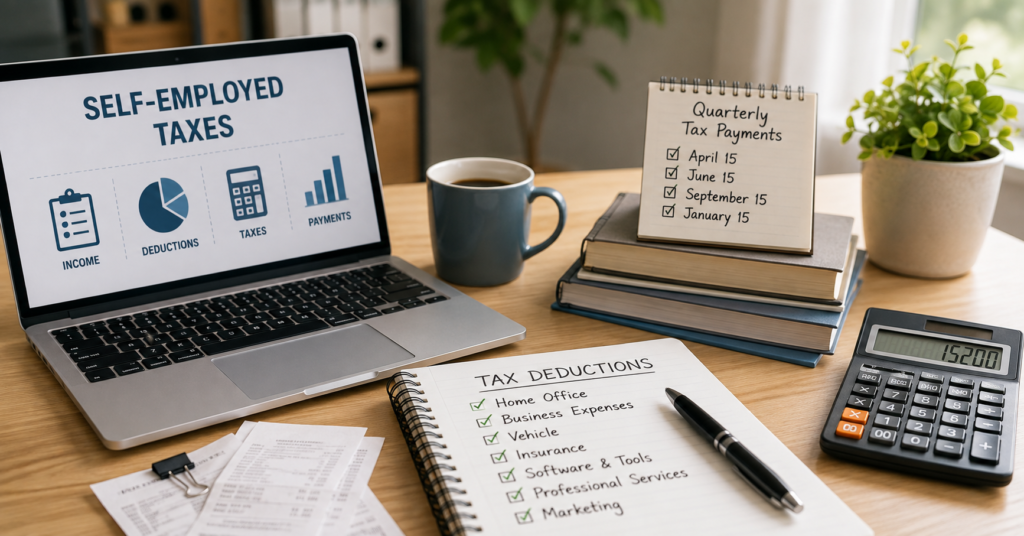
You will be able to deduct a certain amount of cost of your house if it is used solely and regularly for business purposes. It will cover a percentage of rent and mortgage interest, utility bills, property taxes, and homeowner’s insurance according to the proportion of office space to the total area of your house.
2. Business Use of Your Car
All the miles driven in connection with your business operations are also deductible. You can choose between the standard mileage rate (multiplying your business miles by the IRS-set standard rate) or the actual expense method (deducting the exact cost of gas, oil, repairs, insurance, and depreciation based on business use percentage).
3. Software, Subscriptions, and Technology
The digital tools that will be needed to help keep your company going, like graphic design tools, website hosting, domain name registrations, CRM software, cloud computing services, and specialized computer equipment, qualify for full deductions.
4. Professional Services and Continuing Education
Payment of fees for accountants, tax preparation, legal advice, and business coaching services is a write-off. In addition, anything you spend on developing your skills via continuing education, books, seminars, and online classes is deductible.
5. Marketing, Advertising, and Website Designing
Brand marketing is essential for the growth of your venture. Expenditures incurred in advertising via digital platforms, social media promotion, business card creation, tradeshow participation, and website development can all be written off.
6. Health Insurance
Being a self-employed individual who does not have any coverage under his/her spouse’s health insurance provided by his/her employer, you may claim deduction for the entire cost of your premium for medical, dental, and long-term care health insurance for yourself, your spouse, and your dependents.
How to File Taxes Self-Employed: A Step-by-Step Approach
In order to get a grasp of how to file taxes self employed, it is imperative to organize, keep accurate accounts and follow a structural timeline. Below are steps for making your filing as smooth as possible every year:
- Open a Business Account: Do not combine your business and personal expenses into one account. Start a business account where all of your client payments will come and go.
- Keep Track of Your Money: Use accounting programs to keep your receipts, invoices, and other bank documents for the whole year. You need proper receipts for all business deductions that you will be claiming.
- Get Your Tax Forms: Get your Form 1099-NEC, 1099-K and receipts for clients payments.
- Submit the Right Tax Forms: In case of filing your federal income taxes, as a self-employed individual, you would be filing through Form 1040 (Schedule C). This form is used to report your profit/loss from your business, Schedule SE for calculating your self-employment tax, and Schedule 1 for reporting your income adjustments.
Tax Planning for the Self-Employed
Procrastinating on your taxes till April can actually prove to be very expensive for you. The following are some additional benefits of tax planning all year round:
- Pay Your Estimated Tax Payments: Ensure that you remain informed about the dates by which your estimated tax payments are due throughout the year. The payment dates are April 15, June 15, September 15, and January 15.
- Choosing the S-Corporation Status: Once you have exceeded the threshold of your net earnings from self-employment, which is above $60,000-$80,000, choosing the S-Corporation status will be an excellent tax-saving choice.
- Retirement Contributions: By making maximum use of a Solo 401k, SEP-IRA, and SIMPLE IRA accounts, you not only save for retirement but also cut down on your taxable income.
Collaborating with Professionals
The process of paying self-employed taxes doesn’t need to feel like too much for you to bear. While learning about how to utilize write-offs, handle quarterly taxes, and file on time is a skill that needs practice, you don’t have to undertake the challenge on your own. Using a good financial plan will help prevent you from any audits that come your way and help you save more money.
Looking for professional assistance that is personalized to suit your particular freelancing business? Get in touch with our tax professionals at My ASM today.